How to Track Property Sales in Salesforce

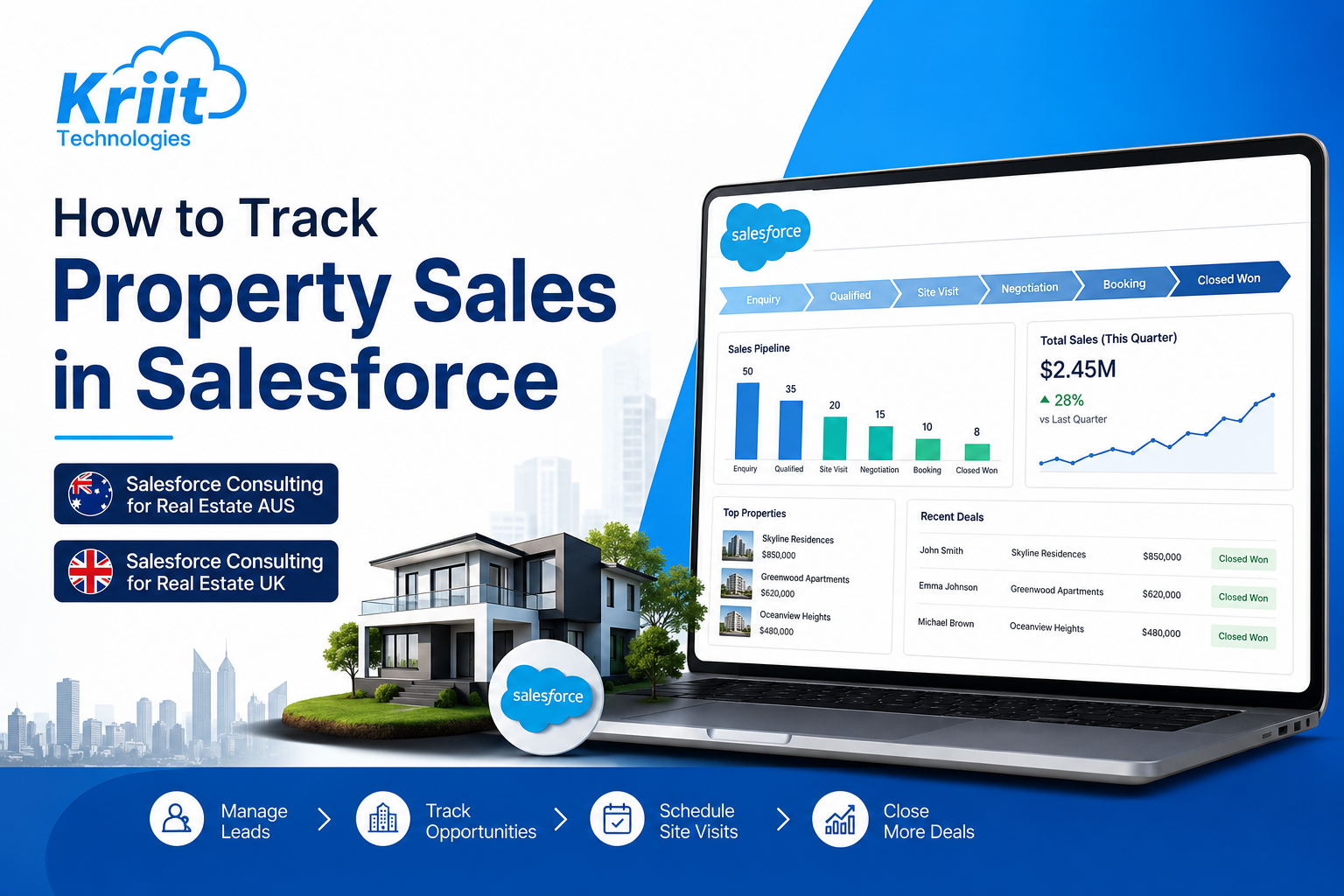
Property sales rarely follow a simple, straight-line process. A prospect may discover a property through a website, enquire through a property portal, speak with a sales representative, schedule a site visit, negotiate pricing, and finally make a booking. When all of this information is managed through spreadsheets, emails, WhatsApp conversations, and separate systems, it becomes difficult to understand what is actually happening with each opportunity.
This is where Salesforce can make a practical difference. With the right setup, real estate companies can use Salesforce to bring property enquiries, customer information, sales activities, site visits, opportunities, and booking details into one connected system.
For businesses looking for Salesforce Consulting for Real Estate AUS or Salesforce Consulting for Real Estate UK the important point is not simply implementing Salesforce. The real value comes from configuring the platform around the company’s property sales process.
Why Real Estate Companies Need Better Property Sales Tracking
A real estate business may handle hundreds or even thousands of enquiries across multiple projects. Sales teams need to know which prospects are new, which have been contacted, who has visited a property, which deals are under negotiation, and which bookings are likely to close.
Without a centralised CRM, sales managers can struggle to answer basic questions such as how many leads are currently active, which projects are generating the most enquiries, which sales representatives have pending follow-ups, or how many opportunities are close to booking.
Salesforce allows this information to be connected. Instead of treating every interaction as a separate activity, businesses can build a complete view of the customer and the property transaction.
How to Track Property Sales in Salesforce
The first step is to design Salesforce around the actual property sales journey. The exact configuration will depend on whether the business is a property developer, real estate agency, broker, or property investment company.
Capture Every Property Enquiry
Property sales tracking starts with capturing enquiries correctly.
Leads can come from a company’s website, property portals, digital advertising campaigns, social media, phone calls, referrals, or other marketing channels. These enquiries can be brought into Salesforce so the sales team has a central record of each prospect.
Information such as the customer’s name, contact details, preferred location, property type, budget, project of interest, source, and enquiry date can be stored against the lead.This gives sales managers a much clearer picture of where their property opportunities are coming from.
Convert Qualified Leads into Opportunities
Once a prospect has shown genuine interest, the lead can be converted into an opportunity.
For a real estate company, an opportunity can represent a potential property transaction. The opportunity can contain information about the project, property type, expected value, expected closing date, sales representative, and current stage.
A properly configured opportunity pipeline might move from initial qualification to property presentation, site visit, negotiation, booking, and finally closed sale.
The stages should reflect the company’s actual sales process rather than using a generic CRM pipeline.
Connect Customers with Properties
One of the most important considerations in real estate CRM implementation is connecting the customer with the property they are interested in.
For example, a customer may be interested in a particular development, apartment type, price range, or commercial unit. Salesforce can be configured to maintain these relationships so sales representatives can understand the context of the opportunity without searching through multiple systems.
For companies managing several projects, this becomes particularly useful because management can analyse sales activity project by project.
Track Site Visits and Customer Interactions
A site visit can be a major milestone in the property buying journey.
Salesforce can be used to record scheduled visits, completed visits, follow-up activities, feedback, and the next action required from the sales representative.
For example, after a site visit, the salesperson may need to send pricing information, arrange another meeting, share documentation, or follow up regarding a specific unit.
Recording these activities in Salesforce means the next step does not depend entirely on someone’s personal spreadsheet or memory.
Automate Follow-Ups After Site Visits
Follow-up is particularly important in property sales because customers often take time before making a decision.
Salesforce automation can help remind sales representatives when a prospect needs to be contacted. Depending on the business process, automated tasks, notifications, emails, or other customer communication workflows can be triggered based on specific events.
The objective is not to automate every conversation. It is to make sure important opportunities do not disappear simply because a follow-up was missed.
Monitor Property Sales Through the Salesforce Opportunity Pipeline
The Salesforce opportunity pipeline provides sales managers with a visual way to understand the current state of their property business.
A manager can see which opportunities are newly qualified, which are progressing, which are under negotiation, and which have reached booking or closure.
This becomes particularly valuable when a company has multiple salespeople working across several properties or developments.
Instead of asking individual team members for updates, management can use CRM data to understand the broader sales position.
Use Salesforce Reports and Dashboards for Property Sales
Salesforce reporting can turn individual transaction records into useful business insights.
A real estate company can create reports to analyse sales by project, sales representative, location, property type, lead source, opportunity stage, or time period.
Dashboards can then give management a high-level view of important sales activity. For example, a sales manager may want to understand whether enquiries are increasing but conversions are falling. Another manager may want to compare the performance of different property projects.
The usefulness of these dashboards depends heavily on data quality and CRM configuration. A dashboard is only as reliable as the information being entered into Salesforce.
How Salesforce Can Help Real Estate Sales Teams
Salesforce is not simply a database for storing customer names. When implemented properly, it can become part of the day-to-day sales operation.
A salesperson can see a customer’s previous interactions, current opportunity stage, property preference, scheduled activities, and next follow-up from a single system. For management, the same data can provide visibility into pipeline value, conversion trends, sales performance, and project-level activity.
This is where working with an experienced Salesforce partner can be valuable. Kriit Technologies works with businesses to understand their processes first and then determine how Salesforce should be configured around those requirements.
Salesforce Consulting for Real Estate in Australia and the UK
Real estate businesses in different markets can have very different operational requirements. A property business in Australia may have a different sales process, technology ecosystem, reporting requirement, and customer journey from a real estate company operating in the UK.
This is why a standard Salesforce setup may not always be the right approach. Businesses searching for Salesforce Consulting for Real Estate AUS generally need a solution that fits their Australian real estate operations, existing systems, sales workflows, and reporting requirements.
Similarly, companies looking for Salesforce Consulting for Real Estate UK may need Salesforce configured around their own business structure, customer journey, integrations, and sales processes.
Kriit Technologies can help businesses evaluate their existing workflows, identify CRM gaps, and configure Salesforce to support a more structured property sales process.
Common Challenges When Tracking Property Sales in Salesforce
Implementing Salesforce does not automatically solve sales tracking problems. Poor data structure, inconsistent data entry, unclear opportunity stages, and disconnected systems can still create problems.
For example, if one salesperson records a site visit as an activity while another creates a separate opportunity stage, management may struggle to produce accurate reports.
The solution is to establish clear processes before the system is configured. Teams should agree on what qualifies as a lead, when a lead becomes an opportunity, what each sales stage means, what information is mandatory, and when a transaction should be considered closed. This process-driven approach helps Salesforce become a reliable source of information rather than another system that employees have to maintain.
How Kriit Technologies Can Help
Kriit Technologies approaches Salesforce implementation and consulting from a business- process perspective. For a real estate company, this can mean reviewing the existing lead journey, sales pipeline, property management requirements, customer interactions, reporting needs, and integrations before recommending a Salesforce solution.
The goal is to make the CRM work for the sales team rather than forcing the sales team to work around the CRM.
Whether the requirement is improving lead management, tracking property opportunities, automating follow-ups, integrating external systems, or building management dashboards, the right Salesforce configuration can provide a more complete view of the property sales cycle.
Final Thoughts
Tracking property sales effectively requires more than knowing how many properties have been sold. Real estate businesses need visibility into the entire journey, from the first enquiry through qualification, site visits, negotiations, booking, and final closure.
Salesforce can provide that visibility when it is configured around the company's actual sales process. For real estate organisations in Australia and the UK, professional consulting can also help ensure that Salesforce supports existing workflows instead of creating unnecessary complexity. Kriit Technologies can help businesses assess their requirements and build a Salesforce environment designed around their property sales operations.
FAQs
1. Can Salesforce be used to track property sales?
Yes. Salesforce can be configured to track property enquiries, customer information, opportunities, site visits, follow-ups, negotiations, bookings, and closed sales. The exact setup depends on the company’s sales process and property business model.
2. Can Salesforce track multiple property projects?
Yes. Salesforce can be structured to manage opportunities across multiple projects, developments, locations, or property types. This allows management teams to analyse sales performance at both an individual project and overall business level.
3. Can Salesforce automate real estate lead follow-ups?
Yes. Salesforce provides automation capabilities that can be used to create follow-up tasks, notifications, emails, and other workflows based on defined business rules. The automation should be designed around the company’s actual sales process.
4. Is Salesforce suitable for real estate companies in Australia and the UK?
Salesforce can be adapted to different real estate business models and markets. However, the implementation should take into account the company’s operational processes, integrations, reporting requirements, and local business needs. This is where specialisedSalesforce Consulting for Real Estate AUS and Salesforce Consulting for Real Estate UK can be useful.
5. How can Kriit Technologies help with Salesforce for real estate?
Kriit Technologies can help real estate businesses assess their CRM requirements, structure sales processes, configure Salesforce, develop automation, integrate relevant systems, and create reporting solutions. The focus is on building a CRM environment that supports the company’s real estate sales workflow.